
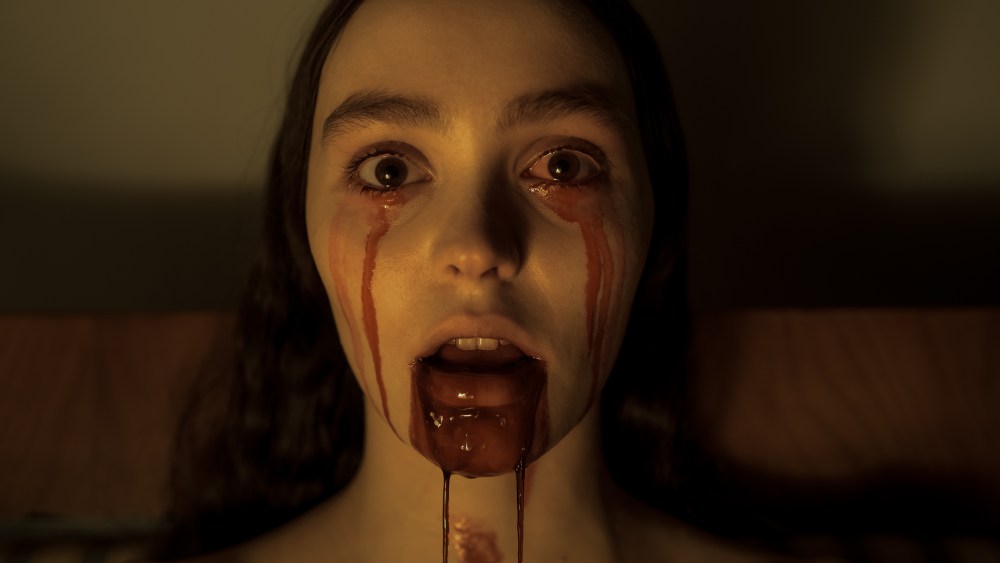
More than a century after its premiere, the vampire film Nosferatu (1922) has been reimagined in Robert Eggers’ new 2024 feature. It’s not the first remake of F. W. Murnau’s silent film; other versions have seen release in 1979’s Nosferatu the Vampyre and 2023’s Nosferatu. Eggers’ adaptation stands apart, though, with its dark, visceral style and strong cast, led by Lily-Rose Depp.
The story follows a young German couple reckoning with a sinister creature coming to their town and is a direct adaptation of Bram Stoker’s novel Dracula, a major literary work that elevated vampires beyond their folklore roots to broad cultural significance. Although the original Nosferatu film took directly from Dracula’s story, it has grown into something much larger.

Although it’s debated as being the first vampire film, Nosferatu (1922) certainly has the most persistent legacy, one that was foundational for the on-screen vampire. Over many decades, the vampire has slowly transformed from a reclusive, malevolent being into a more beguiling, human-like creature.
Partially due to today’s vast catalogue of vampire media, the portrayal of vampires varies widely across film and TV, with some characters as fearsome manifestations of evil (Dracula), some as YA heartthrobs (Twilight, The Vampire Diaries), and others as family-friendly animations (Hotel Transylvania). The vampire occupies a unique position among monsters due to its human appearance, a trait that’s allowed it to to become many things. Out of everything, over time, it’s become more human.
Despite its monstrous nature, the vampire’s familiar form gives it the opportunity to have relationships with people beyond that of mere predator. Now, the vampire has become a kind of representation of a dark side of human nature, sometimes sinister, sometimes violent, but ultimately with some sense of morality, like their mortal counterparts. This modern type of vampire is one Eggers rejects completely.
Nosferatu’s villain, Count Orlok (a renamed version of Count Dracula), is grotesque, corpse-like, and completely devoid of morals. His only goal is to consume, and the object of his desire is Ellen Hutter, a young wife in a nondescript German town, Wisburg. Ellen’s husband Thomas, accepts the opportunity to travel to Transylvania to finalize the Count’s purchase of a residence in their town, unaware of the consequences. While there, the Count feeds on Thomas and intends to kill him, but Thomas escapes. At home, Ellen is plagued with melancholia, seizures, and fits. Meanwhile, Thomas and the Count both make their way to Wisburg, the latter bringing fear of the plague to haunt and hunt the residents. With Ellen in reach, the Count threatens to destroy all she loves if she does not choose to give herself to him. She resists at first, but when she realizes how to destroy the Count and save her husband, she accepts the his request, letting him feed on her until sunrise, when he dies.

Ellen Hutter’s role is that of a traditional, feminine figure–a loving wife and, in the eyes of the Count, an object of desire. The women of Nosferatu and the wider canon of Dracula-inspired works range from passive characters to pure beings who are repulsed by the vampire. No matter the type of character, the women–Ellen in particular, are not allowed to be very active in the story. In contrast, the men drive the narrative; Ellen’s husband takes the journey that shapes Nosferatu. He works, explores, plans. She remains home. His goal is achievement. Hers is to reunite. It’s only in the final, climactic act when Ellen gains agency by choosing to sacrifice herself to bring down Count Orlok.
In the original Nosferatu, made in Germany in the 1920s, Ellen is merely a supporting character, lacking much depth beyond her role as a worried wife. She only appears in a handful of scenes until the final sequence of the film, when she realizes she alone can kill the Count. After letting him into her bed to drink her blood, she miraculously survives and reunites with her husband.

Nosferatu the Vampyre (1979) presents a different story, in which Lucy (a renamed version of Ellen), is a stronger, more defined character, but one who still is defined by her purity, her womanliness. She resists all of Nosferatu’s advances because of her unwavering love for her husband. Although horrified by the evil that he’s brought to Winsburg, Lucy finds motivation to destroy the Count for her husband’s sake, who’s become sicker and sicker since his return from Transylvania. Her sacrifice is in vain, though, as the Count drains her of blood, and her husband becomes a vampire. This trope of the incorruptible woman is not unique to the vampire subgenre, or even horror in general, but is certainly a reflection of antiquated gender roles.
In Eggers’ film, these tropes are subverted, as being a wife is not Ellen’s defining characteristic. Eggers presents a more critical, modern eye toward gender roles, noting how they can be constrictive and oppressive, emphasized through the clothes and the dialogue. But Ellen is no longer a passive female protagonist, whose emotions and role in the story are secondary. She is the catalyst of the story. Although still an object of desire, she is also a desirer herself. The film opens with her alone, in the throes of pleasure, a scene which not only provides foreshadowing but also sets the tone of the story.
Unlike its predecessors, this new Nosferatu places Ellen in the center of the narrative, albeit through an occasionally unsympathetic lens. Ellen’s suffering, melancholia, and possession are on full, unflinching display. Nearly all the characters look down upon her or pity her. The character of Professor von Franz (Willem Dafoe) believes she is susceptible to forces of darkness. The end of the film reveals that even Ellen considers herself wicked, as she shamefully admits that she summoned Nosferatu in her unsatisfied youth. However, Von Franz and Ellen’s husband (Nicholas Hoult) are both sympathetic towards her, suggesting the film’s portrayal as less of a condemnation and more of an understanding.

Although Eggers mostly follows the first film’s timeline, which takes place during Ellen’s adulthood, the opening scene and subsequent references reveal glimpses of Ellen’s youth. Before Thomas, Ellen recalls how she was consumed with desire and unholy feelings, partially her own and partially the effect of the Count. With Thomas, those darker impulses are subdued by their love, but their relationship is overshadowed by her connection to the Count; this traditional marriage, with its demand of submissive femininity cannot make Ellen content. So she chooses to give herself to the Count, undoubtedly to save Thomas and the town. But, also, to finally, fully give in to the draw of darkness by drawing Darkness into her bed, where he latches onto her heart and kills them both.
The detail of the Count drinking a victim’s blood not from the neck as in traditional myth and in the original film but above the heart should not be overlooked. Vampires both literally and figuratively consume; in this film, adding to the metaphor of consummating a union. The drinking of blood is an intimacy of the highest, most grotesque form, which is fitting for the metaphor of evil. This force draws from the heart, the core of human life, which the Count, as a dead thing, lacks. While the human heart, and who it belongs to, may not necessarily be pure, which Ellen was not portrayed as, the heart in general is seen as something ultimately noble, pure, and from which the highest human choices come from. The Count, in contrast, as a malevolent being, cannot hold any of these traits, and acts like a parasitic evil. Down to the core of his being, he is antithetical to human existence.

Although this film raises a question of morality through the lens of death and lust, Count Orlok isn’t just a manifestation of Ellen’s sexual satisfaction. Despite the aspect of sexuality, there is no erasing the ultimate evil of Nosferatu, made clear in moments such as when he towers over Thomas in the castle or when he drains Anna’s young daughters of their blood. He is darkness personified, all the sins at once, a perversion of human nature. There is nothing remotely romantic or liberating about him. He embodies the unholy, the perverse, of which sexuality is part, according to this film. So Ellen’s fate is a warning, a parable of the consequences of feminine desire.
By approaching the story as an examination of female sexuality and the nature of evil, the question Eggers raises is ultimately a moral one. Does indulgence lead to death? Emotional, spiritual, physical death? Perhaps it’s an attempt to examine the fear of the unknown, reflecting the roots of the vampire myth, or perhaps it’s a portrayal of the inward struggle toward our own human impulses.
Eggers saw in the story a depth the previous filmmakers did not see in women. He elaborates on the original film to the extreme degree, a satisfactory take for the modern audience, a film that feels very relevant. Perhaps this was a natural progression of the undertones of the original film, an inevitable conclusion, because it’s Ellen who binds the whole story together. The question of the film comes from her: “Does evil come from within us, or does it come from beyond?” And the answer seems to be: both.






Leave a Reply